
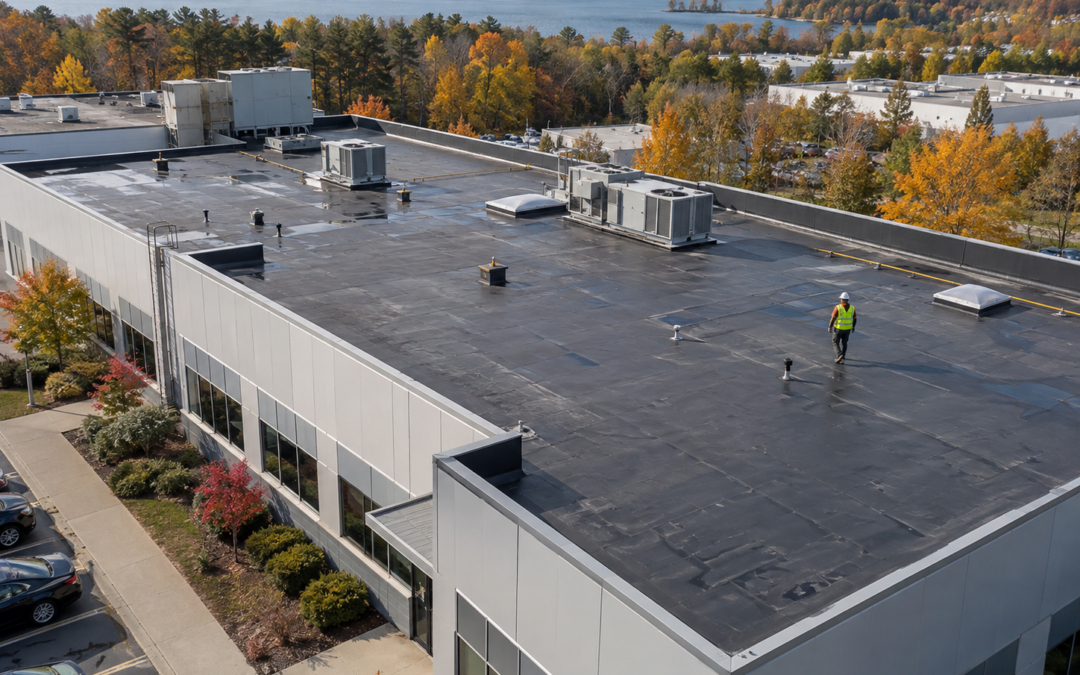
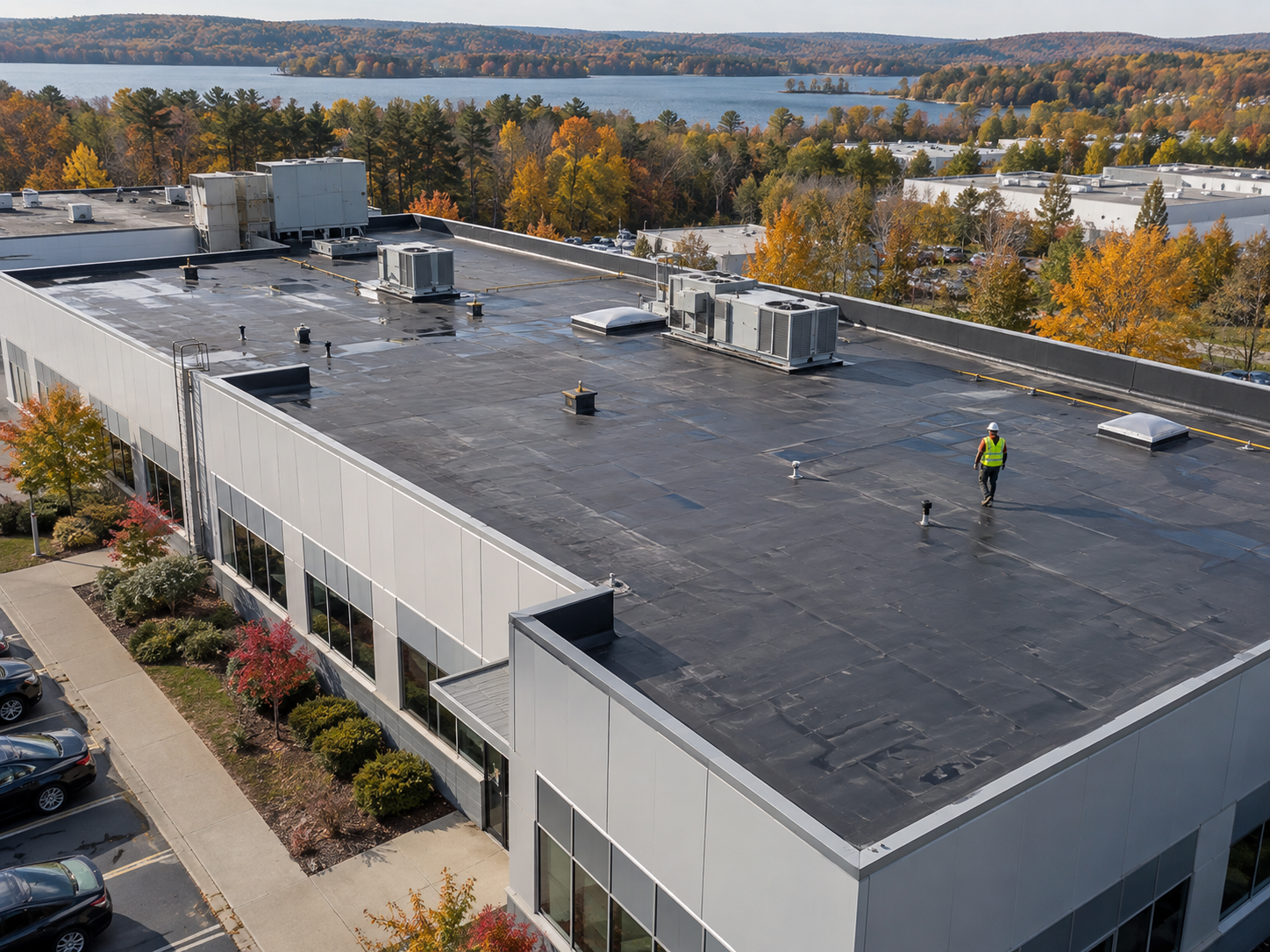
For commercial building owners and facility managers, fall is more than a change in season.
It is a deadline.
The weeks between summer and winter provide one of your best opportunities to inspect, repair and prepare your commercial roof before freezing temperatures make small problems harder to manage.
A partially open seam may not be leaking today.
A clogged drain may not look urgent.
A small puncture around an HVAC unit may go unnoticed.
But send that roof into winter already compromised, and months of rain, freezing temperatures, snow, ice and freeze-thaw cycles can turn small weaknesses into leaks, wet insulation and operational disruptions.
That is why fall roof maintenance matters.
Why the Window Is Closing
Commercial roofing work does not simply stop when temperatures fall.
But colder conditions can narrow the options available.
Certain adhesives, sealants, primers and coatings behave differently in cold weather. Manufacturer guidance from Elevate, for example, calls for additional application procedures below 40 F, with some materials requiring even warmer temperatures.
Cold and wet conditions can also increase drying times and make roof surfaces more difficult to work on.
That makes fall valuable.
If repairs can be identified and completed under favorable conditions, it is usually better than discovering them during an emergency in the middle of winter.
Start With a Fall Roof Inspection
A commercial roof should not be treated as an asset you inspect only after it leaks.
Industry guidance commonly recommends regular roof evaluations, particularly in spring and fall.
Carlisle specifically recommends regular roof walks and checking drains, flashings, loose membrane and ponding areas, noting that clogged drains are especially common during spring and fall.
A fall inspection should focus on:
-
Membrane condition
-
Seams
-
Flashing
-
Drains
-
Scuppers
-
Gutters
-
Roof edges
-
Penetrations
-
HVAC curbs
-
Previous repairs
-
Ponding areas
-
Rooftop traffic damage
-
Debris
The goal is to understand what condition the roof is in before winter begins.
Drainage Should Be Near the Top of the List
Fall means leaves.
Leaves mean clogged drains.
A small amount of debris around a commercial roof drain may not look serious.
But drainage problems can quickly create ponding water.
Carlisle warns that fall leaves, branches and other debris can restrict drains, scuppers and gutters, allowing water to remain on the roof and increase exposure around seams, roof details and low areas.
Now add freezing temperatures.
That standing water may turn to ice.
Drainage becomes even more difficult.
And additional rain or melting snow still needs somewhere to go.
A clean drain in October is much easier to manage than an ice-covered drain in January.
Check Seams Before Freeze-Thaw Cycles Begin
TPO, PVC and EPDM roofing systems depend on properly performing seams and details.
If a seam is already beginning to separate, winter is not going to improve it.
GAF notes that winter conditions can reveal or worsen issues including partially lifted seams, membrane damage and flashing problems.
Water entering a small opening can reach the roofing assembly underneath.
Then temperatures fall.
That moisture freezes.
Then it thaws.
The process repeats.
The roof may enter spring with a much larger problem than it had in fall.
Flashing and Penetrations Deserve Extra Attention
Most commercial roofs contain numerous penetrations.
Think about everything on your roof:
-
HVAC equipment
-
Pipes
-
Vents
-
Electrical conduit
-
Skylights
-
Exhaust fans
-
Parapet walls
-
Roof hatches
Every one of those features creates a transition in the roofing system.
Those transitions depend on properly performing flashing.
A fall inspection should look for:
-
Loose flashing
-
Cracked sealants
-
Open edges
-
Movement around equipment
-
Previous repairs beginning to fail
-
Punctures near service areas
A tiny opening can become the starting point for a very large moisture problem.
Revisit Old Repairs
A commercial roof may have years of repair history.
That history matters.
An area that leaked two years ago may have been successfully repaired.
But it should still be checked.
Older patches and flashing repairs should be reviewed to make sure they remain watertight.
If the same area continues requiring service, the underlying problem may need a more detailed investigation.
Fall is the time to have that conversation.
Not during a winter leak.
What Happens When Moisture Gets Into the Roof?
One of the biggest concerns with a commercial roof is that water can travel beneath the membrane.
The roof may appear normal from above while moisture spreads through insulation.
That can create problems such as:
Wet insulation.
Moisture can compromise insulation performance and expand the scope of future repairs.
Deck deterioration.
Long-term moisture exposure can damage certain roof decks and supporting materials.
Recurring leaks.
Water may travel away from the original entry point, making interior leaks difficult to diagnose.
Interior damage.
Ceilings, walls, equipment, inventory and finished spaces may all be exposed.
Operational disruption.
An active leak over a production area, warehouse, office or customer space can become much more than a roofing problem.
That is why catching water entry early matters.
Winter Can Turn a Drainage Problem Into an Ice Problem
Low-slope commercial roofs are not immune to ice.
IBHS notes that ice can form around drains on low-slope roofs and restrict meltwater from leaving the roof. Water backing up behind ice can contribute to leaks, while trapped snow, ice and water add weight to the roof.
Now imagine starting winter with a drain that was already partially clogged.
The roof is beginning the hardest season of the year with a problem already working against it.
That is preventable.
Watch for Rooftop Debris
Commercial roofs collect more debris than many building owners realize.
You may find:
-
Leaves
-
Branches
-
Packaging
-
Screws
-
Scrap metal
-
HVAC service debris
-
Loose materials
-
Dirt around drains
Debris can block drainage.
Sharp debris can also puncture membranes.
Fall maintenance should include cleaning the roof and making sure service contractors have not left materials behind.
Look at High-Traffic Areas
The areas around HVAC units, roof hatches and other frequently serviced equipment receive more foot traffic than the rest of the roof.
Check them for:
-
Punctures
-
Scrapes
-
Membrane wear
-
Loose walk pads
-
Damage around equipment
-
Dropped screws or fasteners
Finding a puncture while the weather is still favorable gives you more repair flexibility.
Finding it after snow begins melting into the roofing assembly does not.
What Does a Neglected Roof Look Like After Winter?
A commercial roof that enters winter with existing weaknesses may come out of it with:
Open seams
Existing weaknesses may continue to deteriorate through winter weather and temperature changes.
Wet insulation
Small leaks can continue introducing water beneath the membrane.
Damaged flashing
Ice, wind and temperature movement can stress already vulnerable details.
Drainage problems
Debris, snow and ice can combine around drains and scuppers.
Interior leaks
Water may begin appearing inside offices, warehouses or production areas.
Emergency repair costs
Winter service can become more complicated than a planned fall repair.
Business interruption
Leaks do not care whether they occur above inventory, machinery, computers or customers.
Winter roofing problems can quickly become building problems.
Fall Gives You Options
This is the biggest advantage of acting now.
When you inspect a roof before winter, you have choices.
Maybe the roof only needs:
-
Drain cleaning
-
A small seam repair
-
Flashing maintenance
-
A puncture repaired
-
Debris removed
-
An old repair refreshed
-
A damaged section of membrane addressed
Or perhaps the inspection reveals a larger issue.
That is still useful information.
It gives you time to discuss repairs, restoration, coatings or longer-term replacement planning instead of making a major decision during an emergency.
Your Commercial Fall Checklist
Before winter, consider having your roofing professional evaluate:
-
Drains and scuppers
-
Gutters and downspouts
-
Membrane seams
-
Flashings
-
Penetrations
-
HVAC curbs
-
Roof edges
-
Ponding areas
-
Previous repairs
-
High-traffic areas
-
Walk pads
-
Rooftop debris
-
Signs of interior moisture
Document what is found.
Photos and inspection reports can help you track roof conditions and plan future maintenance.
Winter Is Coming Either Way
A commercial roof does not get to skip winter because it has an open seam, clogged drain or overdue repair.
The cold weather is coming.
The question is what condition your roof will be in when it arrives.
Fall gives building owners something winter often does not:
Time to be proactive.
At Commonwealth Roofing Corp., our goal is to help building owners understand what their roof needs before a small issue turns into a larger expense.
Sometimes that's routine maintenance.
Sometimes it's a targeted repair.
Sometimes it is a larger roof-life extension strategy.
The important part is addressing the problem while you still have options.
Do not let the first winter leak become your roof inspection.
Safety, Service, & Quality — every day since 1981.
Louisville: (502) 459-2216
Hebron: (859) 943-0012
Service: (888) 818-4842