When a commercial roof starts showing its age, building owners often assume they have two choices:
Repair it again or replace it completely.
But there can be another option.
Liquid-applied roofing can restore and protect certain existing commercial roofs without immediately removing and replacing the entire roofing system.
When the existing roof is a good candidate, a liquid-applied system can seal vulnerable areas, create a seamless waterproof surface, improve reflectivity and extend the useful life of the roof.
But liquid-applied roofing is not appropriate for every roof.
The existing roof, insulation, drainage, substrate, moisture conditions and coating chemistry all matter.
Here is what commercial building owners and facility managers should understand before considering it.
What Is Liquid-Applied Roofing?
Liquid-applied roofing is exactly what the name suggests.
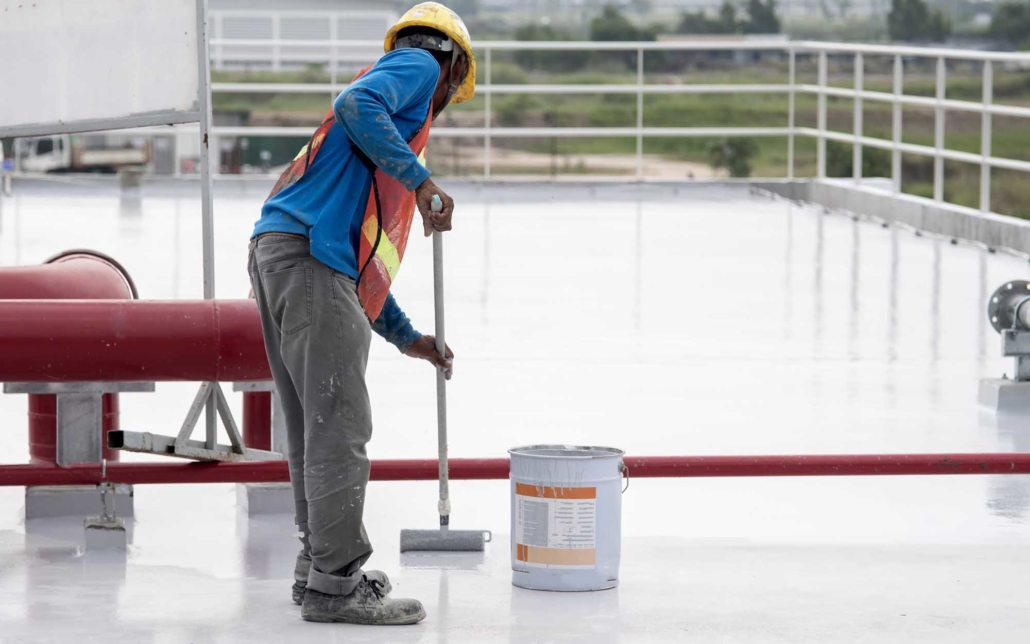
A roofing material begins as a liquid and is applied directly over an existing roof using rollers, brushes, squeegees or spray equipment.
Once cured, the material forms a continuous protective layer over the roof.
Unlike roofing systems constructed primarily from large sheets of membrane, a liquid-applied system can conform around:
- HVAC curbs
- Pipes
- Drains
- Vents
- Skylights
- Parapet walls
- Flashings
- Other complicated rooftop penetrations
Depending on the system, liquid-applied roofing may be used as a protective coating, restoration system or reinforced liquid membrane.
That distinction is important.
Coating vs. Liquid-Applied Membrane
Not every bucket of roof coating represents the same type of roofing system.
Protective Roof Coating
A protective coating is generally applied over an existing roofing system to help protect it from weathering, ultraviolet exposure and moisture.
It may also restore reflectivity and extend the service life of the existing roof.
Reinforced Liquid-Applied System
Some liquid-applied systems incorporate reinforcing fabric or other components within the liquid membrane.
These systems can create a more substantial waterproofing assembly and may be installed across the entire roof or used strategically around difficult details.
GAF, for example, describes reinforced acrylic liquid membranes as monolithic and capable of conforming to complex roof shapes and substrates.
The appropriate system depends on what you're trying to accomplish.
The Main Types of Liquid-Applied Roofing
There isn't one universal liquid roofing material.
Different chemistries have different strengths.
1. Silicone Roof Coatings
Silicone is one of the most common options for low-slope commercial roof restoration.
Once cured, silicone creates a flexible, seamless surface with strong resistance to ultraviolet exposure and water.
One of silicone's biggest advantages is its ability to perform in areas where water occasionally ponds.
GAF specifically identifies silicone systems as suitable for protection against leaks associated with ponding water and prolonged UV exposure.
Silicone may be particularly useful when:
- The roof experiences occasional ponding
- Strong UV resistance is important
- A highly reflective surface is desired
- The roof contains numerous penetrations
- Weather windows for installation are limited
- The existing roof is structurally sound but aging
Silicone is also moisture-cured rather than relying solely on water evaporation. That can provide advantages compared with some water-based coatings when weather conditions are less predictable.
Potential drawbacks
Silicone can become slippery when wet.
It can also collect dirt over time, and future repairs or recoating must use materials compatible with the existing silicone surface.
Those details should be considered during long-term maintenance planning.
2. Acrylic Roof Coatings
Acrylic roof coatings are typically water-based elastomeric products.
They are widely used because they can provide:
- Excellent UV resistance
- Strong reflectivity
- Flexibility
- Relatively simple application
- Good value on appropriate roofs
Acrylic coatings are often particularly useful on roofs with good drainage.
GAF describes acrylic systems as economical, UV-resistant and flexible, while noting that silicone generally performs better where ponding water is a major concern.
Acrylic may be a good choice when:
- The roof has positive drainage
- Ponding water is minimal
- Reflectivity is important
- The existing roof is in generally good condition
- Budget is a major consideration
Weather matters
Because many acrylic products are water-based, they need appropriate temperatures and enough dry weather to cure properly.
Rain arriving too soon after installation can affect uncured material.
That makes weather forecasting especially important during acrylic installations.
3. Polyurethane or Urethane Coatings
Polyurethane coatings are another option within the liquid-applied roofing category.
They are known for:
- Durability
- Flexibility
- Impact resistance
- Resistance to mechanical wear
- Performance in areas receiving greater foot traffic
That can make polyurethane particularly useful around service areas, walkways or rooftop equipment where technicians frequently access the roof.
GAF notes that polyurethane coatings can offer greater impact resistance and durability in areas experiencing mechanical wear or heavier traffic.
Different polyurethane formulations also have different UV and weathering properties, so the complete system matters.
Which Commercial Roofs Can Be Coated?
Liquid-applied systems can potentially be installed over a wide variety of commercial roof substrates.
Depending on the manufacturer and system, compatible surfaces may include:
- TPO
- PVC
- EPDM
- Metal
- Spray polyurethane foam
- Structural concrete
- Certain asphaltic roofing systems
- Previously coated roofs
GAF lists metal, aged single-ply membranes, structural concrete, spray foam and several existing coating surfaces among substrates that may qualify for its coating systems.
But compatibility should never be assumed.
Two roofs made from the same general material may still have different surface conditions, contaminants, repair materials or previous coatings.
That is why adhesion testing and manufacturer requirements matter.
The Most Important Question: Is the Existing Roof a Good Candidate?
Liquid-applied roofing works best when it is restoring a roof that still has a fundamentally sound foundation.
It is not designed to hide major underlying problems.
Before recommending a coating or liquid membrane, several questions should be answered.
Is the roof structurally sound?
A coating cannot repair a failing deck or serious structural deterioration.
Is the insulation dry?
This is critical.
Applying a coating over widespread trapped moisture can leave the underlying problem in place.
If moisture is suspected, additional testing may be needed before deciding whether restoration makes sense.
Are the existing materials secure?
Loose membrane, deteriorated flashing and damaged materials may require repair before coating.
Can the roof drain properly?
Drainage should always be evaluated.
Even when a coating is designed to tolerate ponding water, improving drainage where reasonably possible is better than simply accepting standing water.
Will the coating bond?
Adhesion testing can help determine whether the selected material will properly bond to the existing roof.
Wet Insulation Changes the Conversation
This is one of the most important things building owners need to understand.
You do not want to simply coat over a moisture problem.
Water can become trapped beneath an existing roofing membrane and spread through insulation.
From the surface, the roof may still look relatively normal.
Depending on the situation, moisture investigations may involve:
- Infrared thermography
- Moisture mapping
- Core samples
- Visual investigation
- Previous leak documentation
If wet insulation is isolated, affected areas may sometimes be removed and replaced before the liquid system is installed.
If moisture is widespread, another roofing strategy may be more appropriate.
The goal isn't to coat every roof.
The goal is to determine whether coating this roof makes sense.
Preparation Is Critical
Liquid-applied roofing is only as good as the surface underneath it.
This is why preparation is often one of the most important parts of the installation.
The exact process depends on the existing roof and the manufacturer, but work may include:
Cleaning the surface
Dirt, grease, biological growth and other contaminants can interfere with adhesion.
Repairing damaged roofing
Open seams, punctures, loose material and deteriorated flashing need to be addressed.
Removing failed material
Bad previous repairs or incompatible materials may need to be removed.
Addressing rust
Metal roofing may require rust treatment and repairs before coating.
Correcting drainage problems
Drains should be cleared and obvious drainage deficiencies evaluated.
Performing adhesion tests
Testing helps verify that the proposed coating properly bonds to the existing substrate.
Applying primer when required
Some surfaces require primer before the liquid membrane or coating is installed.
Skipping preparation because the final material "covers everything" is a mistake.
The Details Come First
A commercial roof contains dozens — and sometimes hundreds — of transitions.
Those details often receive additional attention before the field of the roof is coated.
Common areas include:
- Seams
- Fasteners
- Pipe penetrations
- Drains
- HVAC curbs
- Skylights
- Roof edges
- Parapet walls
- Flashing transitions
- Previous repairs
Depending on the system, contractors may use mastics, reinforcement fabrics or heavier applications of liquid material around these areas.
Once those details are properly treated, the larger field of the roof can be coated.
How Is Liquid Roofing Applied?
Application depends on the manufacturer and material.
Common methods include:
Roller Application
Similar in appearance to painting, although coating thickness and coverage requirements are much more precise.
Squeegee Application
Material is distributed across the roof and then worked to the required coverage rate.
Spray Application
Specialized equipment can apply coatings quickly across large roof areas.
Brush Application
Brushes are commonly used around details, penetrations and smaller areas.
The method matters less than achieving the correct finished system.
A coating that is applied too thin may not perform as intended.
Thickness Matters
Commercial roof coatings are not simply decorative paint.
Manufacturers specify coverage rates and minimum thicknesses.
The installer must apply enough material to produce the intended cured membrane.
Quality-control procedures may include:
- Tracking material usage
- Measuring wet-film thickness
- Measuring dry-film thickness
- Checking coverage
- Inspecting details
- Documenting completed work
Using fewer gallons than the system requires may make the roof look coated without actually producing the specified roofing system.
What About Ponding Water?
Ponding water deserves special attention on low-slope commercial roofs.
Water that remains after a rainfall can place additional stress on roofing materials and may signal drainage problems.
Different liquid roofing chemistries handle ponding differently.
Silicone
Silicone is generally well suited for areas exposed to ponding water.
Acrylic
Traditional acrylic coatings generally prefer roofs with positive drainage and can be more vulnerable to prolonged standing water.
GAF's technical guidance, for example, specifically identifies prolonged ponding as challenging for acrylic systems and provides silicone as an option for certain ponding areas.
But there is an important distinction:
A coating's ability to tolerate ponding water does not mean drainage problems should be ignored.
If drains are blocked, slopes are incorrect or significant water consistently remains on the roof, the cause should still be investigated.
Why Are Most Coated Roofs White?
Many liquid-applied commercial roofing systems use white or light-colored topcoats.
The reason is reflectivity.
A reflective roof surface can absorb less solar energy than a darker surface, which may reduce roof surface temperatures and potentially lower cooling loads depending on the building, climate, insulation and HVAC conditions.
Some coating products are specifically listed by the Cool Roof Rating Council for solar reflectance and thermal emittance.
Reflectivity can be valuable.
But it shouldn't be the only reason to coat a roof.
Waterproofing and roof condition come first.
The Biggest Advantages of Liquid-Applied Roofing
Seamless Protection
Once installed, the system creates a continuous surface instead of relying primarily on long field seams.
Excellent Around Details
Liquid materials can conform around complex shapes, penetrations and equipment.
Less Tear-Off
When conditions allow restoration, existing roofing materials may remain in place, reducing demolition.
Less Disruption
A restoration project can sometimes interfere less with building operations than a complete roof replacement.
Reflectivity
Light-colored systems can improve solar reflectance.
Roof-Life Extension
A qualified existing roof may gain additional service life without immediate replacement.
Renewability
Some coating systems can potentially be cleaned, repaired and recoated later rather than immediately removed.
Manufacturers such as GAF offer certain coating-system guarantees in the 10- to 20-year range depending on system design, product selection, application and contractor qualifications.
That does not mean every coating automatically lasts 20 years.
System design matters.
What Liquid-Applied Roofing Cannot Do
Liquid roofing has significant advantages, but it has limits.
A coating does not automatically fix:
- Saturated insulation
- Structural damage
- Severely deteriorated decking
- Major drainage deficiencies
- Unstable existing membrane
- Failed substrate adhesion
- Serious rust damage
- Poorly designed roof details
Think of liquid-applied roofing as a restoration tool, not a magic covering.
If the existing roof underneath is failing extensively, covering it doesn't make those problems disappear.
What About Rooftop Traffic?
Some liquid-applied surfaces can be damaged by repeated mechanical traffic.
HVAC technicians, electricians and maintenance workers may follow the same routes across a commercial roof throughout the year.
Where regular traffic is expected, the roofing plan may incorporate:
- Walk pads
- Designated pathways
- Higher-durability materials
- Additional protection around service areas
Polyurethane systems, in particular, may be considered where greater impact or traffic resistance is needed.
Traffic patterns should be considered before installation — not after damage appears.
How Long Does Liquid-Applied Roofing Last?
There is no single answer.
Service life depends on:
- Existing roof condition
- Material chemistry
- Applied thickness
- Preparation
- Climate
- Drainage
- Foot traffic
- Installation quality
- Maintenance
- Manufacturer requirements
Some manufacturer-backed systems offer 10-, 15- or 20-year limited guarantees when installed according to the required specifications.
The more important question is:
How long will the specific system designed for your roof perform under your building's conditions?
That requires evaluating the roof first.
Can a Coated Roof Be Recoated Later?
Often, yes.
One of the major attractions of many coating systems is renewability.
If the underlying roof remains suitable, a future maintenance cycle may involve:
- Inspecting the existing coating
- Making localized repairs
- Cleaning and preparing the surface
- Testing adhesion
- Applying additional compatible coating
This can potentially extend the roof's service life again.
But recoating isn't automatic.
The existing system still needs to be evaluated.
How Should a Coated Roof Be Maintained?
A restored roof still needs maintenance.
At minimum, commercial building owners should consider professional inspections in the spring and fall and after major storms.
Inspections should pay close attention to:
- Drains
- Scuppers
- Penetrations
- Flashings
- HVAC curbs
- High-traffic areas
- Previous repairs
- Coating damage
- Debris
- Ponding areas
Small coating damage is usually easier to address when it is discovered early.
Waiting until water reaches the interior defeats much of the benefit of proactive roof management.
Coating vs. Replacement: How Do You Decide?
This is the question most building owners ultimately need answered.
Liquid-applied restoration may make sense when:
- The roof is structurally sound
- Most insulation remains dry
- The membrane is still salvageable
- Problems are localized
- Adhesion testing is successful
- Drainage is manageable
- The building owner wants to extend roof life
- A compatible coating system exists
Replacement may make more sense when:
- Moisture is widespread
- Decking is deteriorated
- The existing system is extensively failing
- Too many repairs are required
- Drainage requires major reconstruction
- The roof has reached the point where restoration no longer provides good value
There is no advantage in coating a roof that should be replaced.
There is also no advantage in replacing a roof that can still be responsibly restored.
The condition of the roof should drive the decision.
What Does Liquid-Applied Roofing Cost?
There is no meaningful universal price per square foot.
Several factors influence cost:
- Roof size
- Existing system
- Condition
- Number of penetrations
- Amount of repair work
- Moisture removal
- Coating chemistry
- Required thickness
- Reinforcement
- Primer requirements
- Access
- Warranty requirements
- Labor
- Rooftop equipment
- Drainage corrections
A simple, open roof requiring minimal repair will be very different from a heavily congested roof containing dozens of HVAC units and penetrations.
The best comparison is not simply:
Coating price vs. replacement price.
The better question is:
Which option gives this building the best combination of performance, service life and cost?
Questions to Ask Before Approving a Liquid-Applied Roof
Before selecting a system, ask your roofing contractor:
What is the condition of the existing insulation?
Has the roof been checked for trapped moisture?
Why is this coating chemistry appropriate for this roof?
Is the existing membrane compatible with the product?
Will adhesion testing be performed?
How will seams and penetrations be treated?
How will ponding areas be handled?
What thickness will be installed?
How will thickness be verified?
What repairs are required before coating?
What warranty or guarantee is available?
What maintenance will be required afterward?
A contractor should be able to explain those answers clearly.
The Bottom Line
Liquid-applied roofing can be an excellent tool for extending the life of a commercial roof.
It can create seamless waterproofing, protect complicated details, improve reflectivity and potentially delay the disruption and expense of complete roof replacement.
But the material itself is only part of the equation.
Inspection matters.
Moisture matters.
Preparation matters.
Product selection matters.
Application thickness matters.
Installation quality matters.
And most importantly, the condition of the existing roof matters.
At Commonwealth Roofing Corp., our goal is not to recommend a coating simply because coatings are available.
Our goal is to determine what your roof actually needs.
Sometimes that's a repair.
Sometimes it's maintenance.
Sometimes a liquid-applied roofing system can extend the useful life of the roof you already have.
And when replacement is truly necessary, we'll help you understand why.
Safety, Service, & Quality — every day since 1981.
Louisville: (502) 459-2216
Hebron: (859) 943-0012
Service: (888) 818-4842