
When a commercial roof develops a leak, most people look for the obvious signs first.
A ceiling stain. Standing water. An open seam. Damaged flashing.
But sometimes the bigger problem is something you cannot see from the surface.
Moisture can become trapped inside a commercial roofing assembly, including within the insulation beneath the membrane. A roof may appear relatively normal from above while moisture is spreading underneath.
That is why understanding what is happening below the membrane can be an important part of managing an aging commercial roof.
A Dry Surface Does Not Tell the Whole Story
Commercial roofing systems contain multiple layers.
Depending on the system, those layers may include the membrane, cover board, insulation, vapor-control components and roof deck.
Once water gets beneath the membrane, it may travel away from the original entry point.
That means the location of an interior leak doesn't always tell you exactly where the roof is allowing water in.
And when the weather dries out, the surface of the roof may look perfectly normal again.
Infrared Imaging Can Reveal Clues
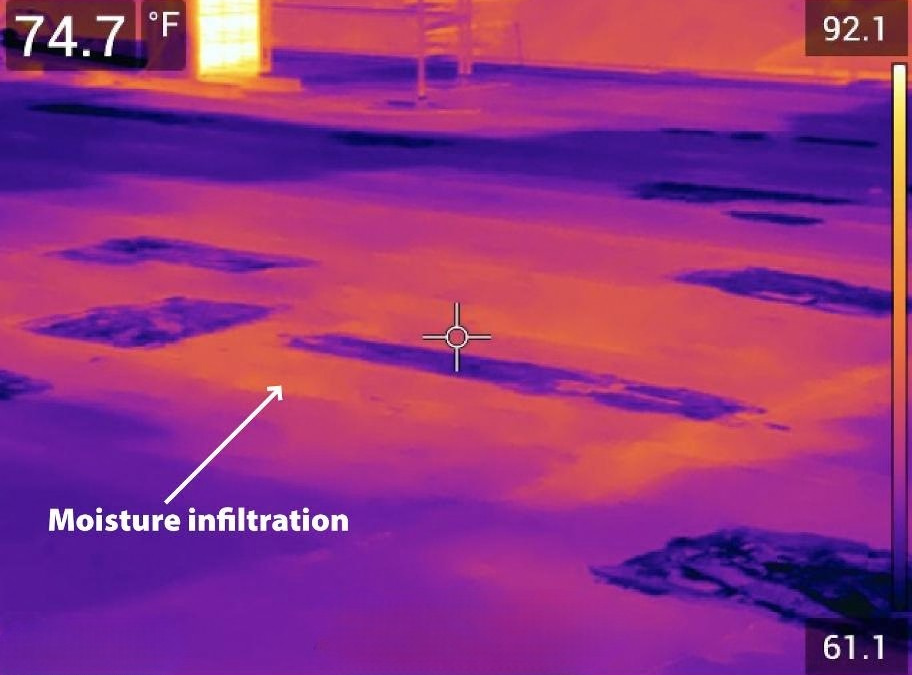
One way roofing professionals investigate suspected moisture is through infrared thermography.
Wet and dry roofing materials can release stored heat at different rates. Under appropriate conditions, infrared equipment can identify temperature differences that may indicate moisture beneath the roof surface. Tremco describes infrared analysis as a method for locating suspected wet insulation, while its broader roof-assessment process combines thermography with core samples, mapping and analysis.
The result can be a much clearer picture of what is happening beneath a large commercial roof.
Thermal Images Aren't the Final Answer
An infrared camera does not simply take a picture and declare an area wet.
Thermal anomalies can have different causes.
That's why suspicious areas should be evaluated by experienced professionals and, when appropriate, confirmed through additional testing such as targeted core samples.
The goal is not simply to find a different temperature.
It's to determine why that area is behaving differently.
Wet Insulation Can Change Your Options
Knowing where moisture exists can help a building owner make a more informed decision.
Imagine two roofs that look similar from the surface.
One has isolated wet insulation around a few problem areas.
The other has moisture spread throughout large portions of the roofing assembly.
Those roofs may require very different strategies.
If moisture is limited, targeted repairs and replacement of affected materials may sometimes be possible.
If moisture is widespread, a larger restoration or replacement strategy may make more sense.
The important part is having the information before making the investment.
Consider Testing Before a Major Roofing Decision
Moisture analysis can be particularly useful when you're considering significant work on an existing roof.
That may include:
- Investigating recurring leaks
- Evaluating an aging roof
- Planning a restoration
- Considering a roof coating
- Evaluating whether a recover is appropriate
- Documenting conditions after severe weather
- Developing a longer-term roof budget
The more you know about the existing roofing assembly, the easier it becomes to choose the right solution.
Documentation Helps With Planning
A good roof assessment doesn't just identify problems.
It creates a record.
Photos, moisture maps, repair histories and inspection reports can help facility managers understand how conditions change over time.
That information becomes especially valuable when you're deciding whether to keep repairing an existing roof or begin planning for larger work.
Rather than making decisions based only on roof age, you can make them based on actual roof condition.
Find the Problem Before Winter Finds It
Fall is a useful time to evaluate questionable areas.
Cold weather, freeze-thaw cycles and winter precipitation can make existing weaknesses more difficult to manage.
Finding hidden moisture now can provide time to evaluate repairs while conditions are more manageable.
At Commonwealth Roofing Corp., we believe good roofing decisions start with good information.
Sometimes a building needs a new roof.
Sometimes it needs targeted repairs, maintenance or another roof-life extension strategy.
The first step is understanding what is actually happening beneath the surface.
Safety, Service, & Quality — every day since 1981.
Louisville: (502) 459-2216
Hebron: (859) 943-0012
Service: (888) 818-4842